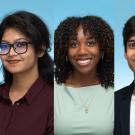
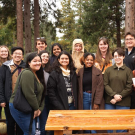
In the summer of 2025, four EPM graduate students put what they’ve learned in the classroom into practice — collaborating with community-based organizations to produce research, policy briefs, and other useful deliverables that could move the needle on some of the most persistent inequities in transportation planning. Their experiences reveal what environmental justice work looks like up close, and why it matters.
As research faculty at the Institute of Transportation Studies and Director of the Transit Research Center, I center my research on sustainable transportation, travel behavior, and environmental policy. I was so excited to join EPM as a faculty advisor, and look forward to working with students interested in transportation and bridging the gap between the classroom and the 'real world'—connecting our students directly with the practitioners, policymakers, and community leaders who are shaping California’s future.
My background is an example of what you majored in in college may not be where you end up later in life. The Great Recession upended my original life plans of being a professor in Asian Studies (my undergrad degree). I ended up getting a “real job” in construction management, which led to a career in stormwater inspection and compliance. After 10 years in the private sector I moved to the regulator side. Despite my experience I could not move beyond an analyst position at the State due to lacking a science degree.
My name is Israel Ademola Okeyinka, and I am a second-year student in the Environmental Policy and Management program at UC Davis. My area of interest is in waste management policies and the circular economy. I hold a BSc in Environmental Science and Resource Management from the National Open University of Nigeria, with 4 years of professional experience in environmental education, solid waste management, recycling and upcycling, circular economy, sustainability, and community-based projects.
Morgen Snyder graduated from the UC Davis Environmental Policy and Management program in June of 2025. Her bachelor’s degrees in Political Science and Legal Studies were awarded from Illinois State University in 2017. Prior to attending UC Davis, Morgen worked in International Compliance law for 6 years as a paralegal. She started her career in Washington, DC, working for an international law firm, Steptoe and Johnson. Morgen eventually took a job as a paralegal secondee for Meta, where she worked supply chain and international compliance issues.
Alexandra (Lexi) Yokomizo is a current second year in the EPM Program with specializations in water resource management and environmental justice. She hopes to use her research background and management knowledge from the EPM program to lead research programs that center intersectional environmentalism in aquatic systems where the environment and the communities that rely on them are recognized for their interconnectedness.
Sam Stromberg is a second year MS student in Environmental Policy and Management at UC Davis. He graduated Summa Cum Laude from the University of Kentucky with a Bachelor’s degree in Economics and Environmental Studies. His current work focuses on biodiversity policy and habitat conservation through policy analysis, data science, and GIS/remote sensing methods. Sam plans to work on high impact biodiversity issues with a mission driven organization.
Erica I graduated from the EPM program in June 2025 while working full time as a Policy Associate at Californians Against Waste (CAW). When she joined CAW in March 2024, she stepped directly into an effort to update the California Air Resources Board’s (CARB) Landfill Methane Rule, a regulation aimed at identifying and mitigating methane emissions from landfills across the state. The project quickly became the centerpiece of her role at CAW. Because Erica was working full-time and enrolled full-time, her practicum and coursework needed to integrate with her job. To do this, she centered her academic work on landfill methane research, writing papers on landfill methane policy, researching emissions trends, studying community impacts at facilities like the Chiquita Canyon Landfill, and developing policy briefs based on her research and findings. This overlap helped Erica apply what she learned in class to real policy decisions.
1st year EPM student Kyle Benestad wrote an op-ed responding to federal executive actions that expand oil drilling and remove ocean protections. Originally written for a core EPM class, the piece was published in the San Francisco Chronicle on November 20th.
When the Graduate Program of Environmental Policy and Management launched EPM Connect in 2022, the vision was simple: create meaningful mentorship connections between current students and experienced environmental professionals. What started as a pilot program pairing students with members of the program's External Advisory Committee has blossomed into a comprehensive initiative that's becoming an vital part of the EPM student experience.
Fall quarter has been off to a busy start! The Graduate Program of Environmental Policy and Management (EPM) works in collaboration with three student committees to host a range of events to cultivate community, foster meaningful connections and help new students as they transition to UC Davis.
At the University of California, Davis, we believe in equipping our students with the knowledge and skills to address complex environmental challenges. In the Environmental Policy and Management (EPM) program, you will gain cutting-edge skills and experience in applying environmental science to real-world policy and management issues.
September sees a return of students and bicycles, creating a bustling campus atmosphere after a slow summer. We are excited to welcome our new and returning graduate students back to campus! This year's cohort of 33 students has a wide range of professional experience in planning, policy, water resources, education and agriculture and are joining us from near and far including India, Taiwan, China, Virginia, Kentucky, New York and from all over California.
“Where does your water come from?” is a question I’ve been asking a lot this summer.
We interact with water every day, but we are often geographically isolated from where our water comes from, the environmental and economic costs of delivering it, and the legal and physical infrastructure that ensures water security, sustainable use, and resilience. Water education is one of the most important tools we have to fill in the gap, and because water systems are so complex and tied to place, experiential learning is a crucial part of water education because it allows us to see how systems actually work versus how the rules say they should work.