


Deep Dive into California Environmental Quality Act (CEQA) Exemptions
What Are They, and Why Are they Being Used?
Every year, the California Environmental Quality Act (CEQA) manual is updated, making the previous year’s manual obsolete. A book treasured by CEQA practitioners, the manual is turned into a dense paperweight that gets heavier each year. At the same time, exemptions to CEQA are limiting this foundational law’s domain.
The California Environmental Quality Act (CEQA) is a state law requiring that projects led, funded, or approved by the state to undergo environmental review and a public disclosure and comment process if they can cause any significant impacts to environmental resources. Since its passage in 1970, policymakers, CEQA practitioners, academics, and community groups have debated CEQA and its tensions between environmental justice, public transparency, administrative costs, and litigation burdens. The rise of NIMBY pushback against higher density housing using CEQA highlights a recognition that CEQA processes might hinder statewide goals meant to benefit the environment. To combat CEQA abuse and stay on track with state initiatives, lawmakers have been making exemptions for a variety of CEQA projects. These statutory exemptions are defined as statutory provisions that exempt projects from undergoing the CEQA environmental review process.
In 2025, the California Legislature passed the most sweeping CEQA reform since the law was created, including new exemptions among other policy changes. This reform and other recent exemption changes impact how housing, transit, infrastructure, and more are developed throughout the state. As California chases its climate and environmental goals and the list of exemptions lengthens, policymakers, local governments, and communities must understand the scope and types of projects covered under these exemptions and if exemptions are effectively being used by project applicants and agencies. Are all these new CEQA exemptions helping California reach its goals, and is CEQA now left with too many holes? We set out to answer these questions for the League of California Cities.
Why does CalCities care about CEQA exemptions?
CalCities is a statewide non-profit that provides advocacy and educational services to 473 of California’s city governments. Working on behalf of such a diverse set of members – nearly all cities in California – CalCities works to ensure that local government concerns are heard by the State Legislature and that cities have the resources they need to understand new policies. That means having non-partisan data and analysis to inform educational materials for city officials and policy platforms. From our client contact, Melissa Sparks-Kranz, we learned that the concerns of cities mirror the tensions in CEQA. Local control in decision making is a priority for cities, but so are goals like economic development, climate resiliency, and housing progress. Since cities and local governments often lead CEQA implementation for projects, CEQA exemptions can lift some of the burden off of city officials. Still, keeping track of new exemptions in order to apply them presents a new burden.
Our Approach
Our aim was to answer two main questions:
What has recent CEQA exemption legislation focused on?
How often are these "new" and newly modified exemptions used?
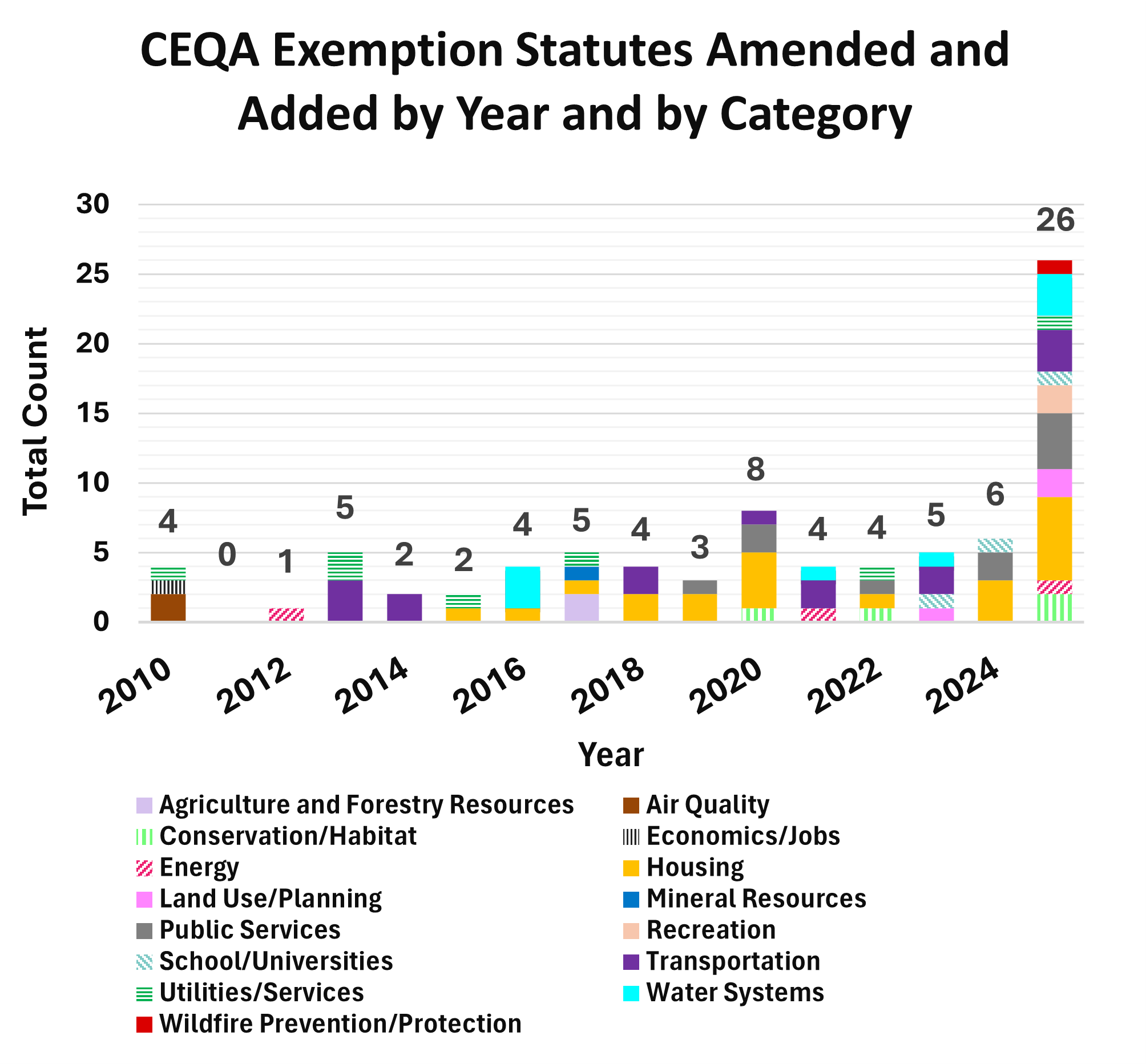
Our team collaborated on three key deliverables for CalCities. First, we produced a handout that shows recent trends in CEQA exemption legislation and highlights common project categories covered by these exemptions. Right from the start, we used skills from our core EPM classes for our Policy Clinic. The bulk of our initial data collection relied on legislation tracking, a centerpiece of ENV 202 - Policy Development and Implementation, which we cross-referenced with CEQA Statute and Guidelines handbooks published by the California Association of Environmental Professionals (AEP). This handout provides CalCities and local planners a quick summary of the mounting exemption legislation for various project types and which project types are affected the most. Once we knew which CEQA exemptions the Legislature had recently added and amended (Figure 1), we started on our second handout reviewing usage patterns. Combining our legislative research and the California Governor’s Office of Land Use and Climate Innovation’s (LCI) CEQANet database, an online database of CEQA project documents, this handout includes specific exemption information to give planners a quick guide to popular exemptions and where to find these exemptions in the text of CEQA. All of our work is brought together in our final analytical report that distills what our findings mean.
Our Takeaways
Our work is a proof of concept for analysis of exemption notices using the CEQAnet Database. As members of the public, it’s easy to assume that lawmakers take the time to evaluate policies after they are created. An eye-opening part of this project was learning that the state’s central repository of CEQA exemption use documents, called Notices of Exemption or NOEs, is missing a large chunk of data, making investigations into exemption use more difficult. Prior to 2024, agencies could skip filing notices of exemption with the state and instead filing with just the local county offices (or avoid filing an NOE altogether with a significant time delay). That means a lot of the information on how exemptions have been used is buried in County Clerk files. Now, after recent reporting requirements under SB 69 (2023), the CEQAnet database will hold all filed NOEs going forward. We learned that more filing requirements can make tracking exemption use easier, but strictly requiring notices for all exempted projects may undermine the goal to reduce the administrative burden of projects.
We also found that the Legislature has written CEQA exemptions for a wide range of projects, including bicycle transportation, solar energy, and habitat restoration, but exemption use is uneven. Two exemptions that are built into large policy programs and agency initiatives, an exemption for linear broadband internet deployment and the Statutory Exemption for Restoration Projects (Figure 2), have been used often, while use of water infrastructure exemptions almost never showed up in our data. New housing project exemptions are plentiful, but some of the most used housing exemptions are not used consistently year to year. And perhaps unsurprisingly, categorical exemptions, the CEQA exemptions in regulation created by the California Natural Resources Agency for projects that don’t cause significant environmental impacts, are cited far more often than exemptions created by the legislature. Categorical exemptions generally apply to small or minimally invasive projects. Of all the exemptions we tracked, the most applied exemption was the Class 1 categorical exemption for minor changes and repairs to existing facilities, accounting for about 40% of all NOEs submitted.
Our analysis just scratched the surface of CEQA exemption use patterns. We hope our work provides convenient resources for people trying to stay up to date with CEQA reform while spurring conversations about how different groups coordinate and interact to create, apply, and challenge CEQA exemptions. For more on our data, findings, and process, check out our report CEQA Exemption Legislation handout and CEQA Exemption Use handout (coming soon).

This article is the fifth in a series of seven that highlight Policy Clinic projects completed by EPM masters students in collaboration with our partners. On behalf of the Graduate Program of Environmental Policy and Management, we'd like to give special thanks to Melissa Sparks-Kranz with League of California Cities for their partnership on this project.
The views, opinions and recommendations expressed in this article and report are those of the authors and do not necessarily reflect the official policy or position of the Graduate Program of Environmental Policy and Management at UC Davis.