


Climate Collaboratives: Resilience in a Time of Change
Climate change is impacting communities across the country, and no community can address these impacts alone. It does not respect jurisdictional lines, operate on budget cycles, or wait for the next election. Climate collaboratives - the networks of organizations working together to respond to the climate emergency - face a similar problem: they are doing essential work behind the scenes in a funding and policy environment that was not designed to sustain them.
What struck me most was the gap between the urgency of the problem and the invisibility of the work - climate change moves beneath the surface, and so do the organizations trying to coordinate a response to it. Working on this project felt like a small act of resistance against that invisibility."
—Abel Kebasso, UC Davis EPM Policy Clinic
Climate collaboratives operate as networks that bring together local governments, nonprofits, academic institutions, community-based organizations, tribes, and, in some cases, private sector partners to coordinate climate action across boundaries that no single agency controls. They do not pass laws, draft policy, or develop plans - they convene stakeholders, align priorities that cross city and county lines, and help communities access funding and technical capacity needed to achieve resilience outcomes. Climate collaboratives exist across the country and are shaped by the regional context, political environment, and institutional landscape in which they operate.
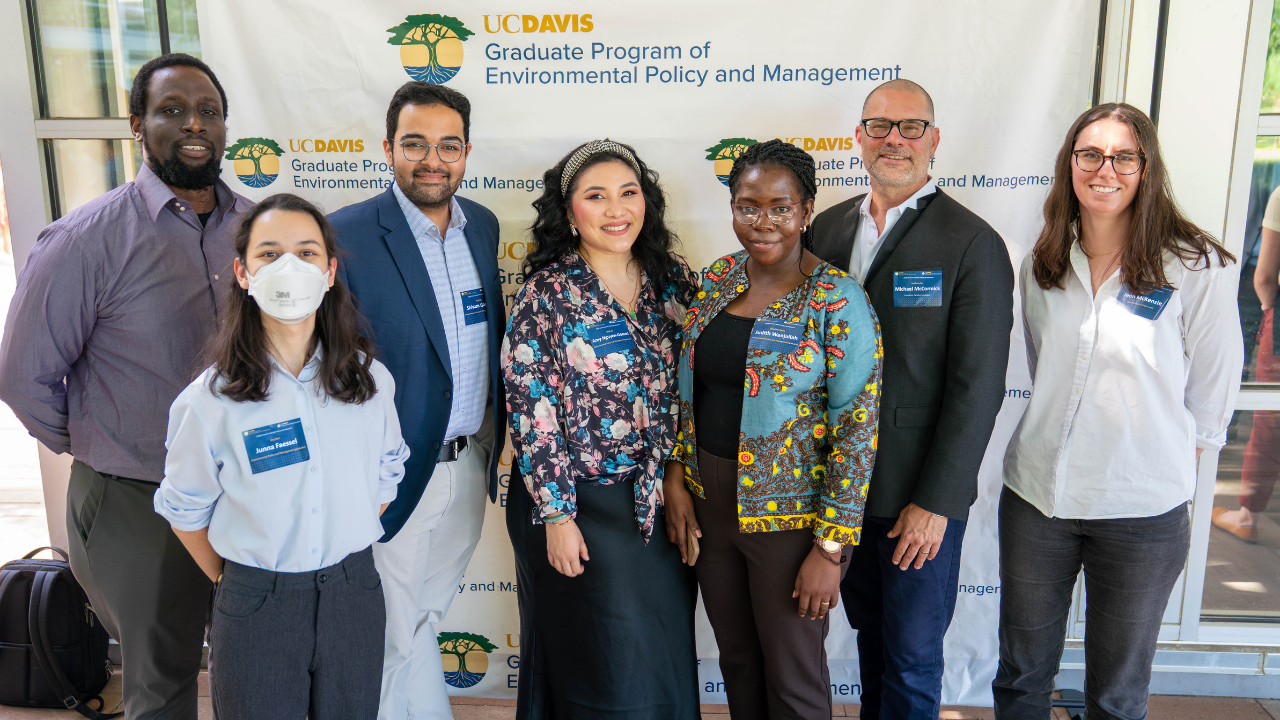
Graduate students participating in UC Davis’ Environmental Policy and Management Policy Clinic (Project Team) with support from Farallon Strategies - a consulting firm with deep roots in the regional climate collaborative space interviewed climate collaborative managers to understand how the landscape that climate collaboratives operate within, and the challenges they face, have changed in the last ten years, since the 2019 Institute for Sustainable Communities’ report Regional Collaboratives for Climate Change: A State of the Art was published. The UCD provides recommendations for strengthening collaboratives’ capacity to attract resources, support, activate more members, and scale up regional action. At the National Adaptation Forum held in May 2026, findings from this research were presented to a national audience of practitioners and met with significant interest and follow-up - an early signal that the questions this project was asking mattered to the people doing the work.
Approach
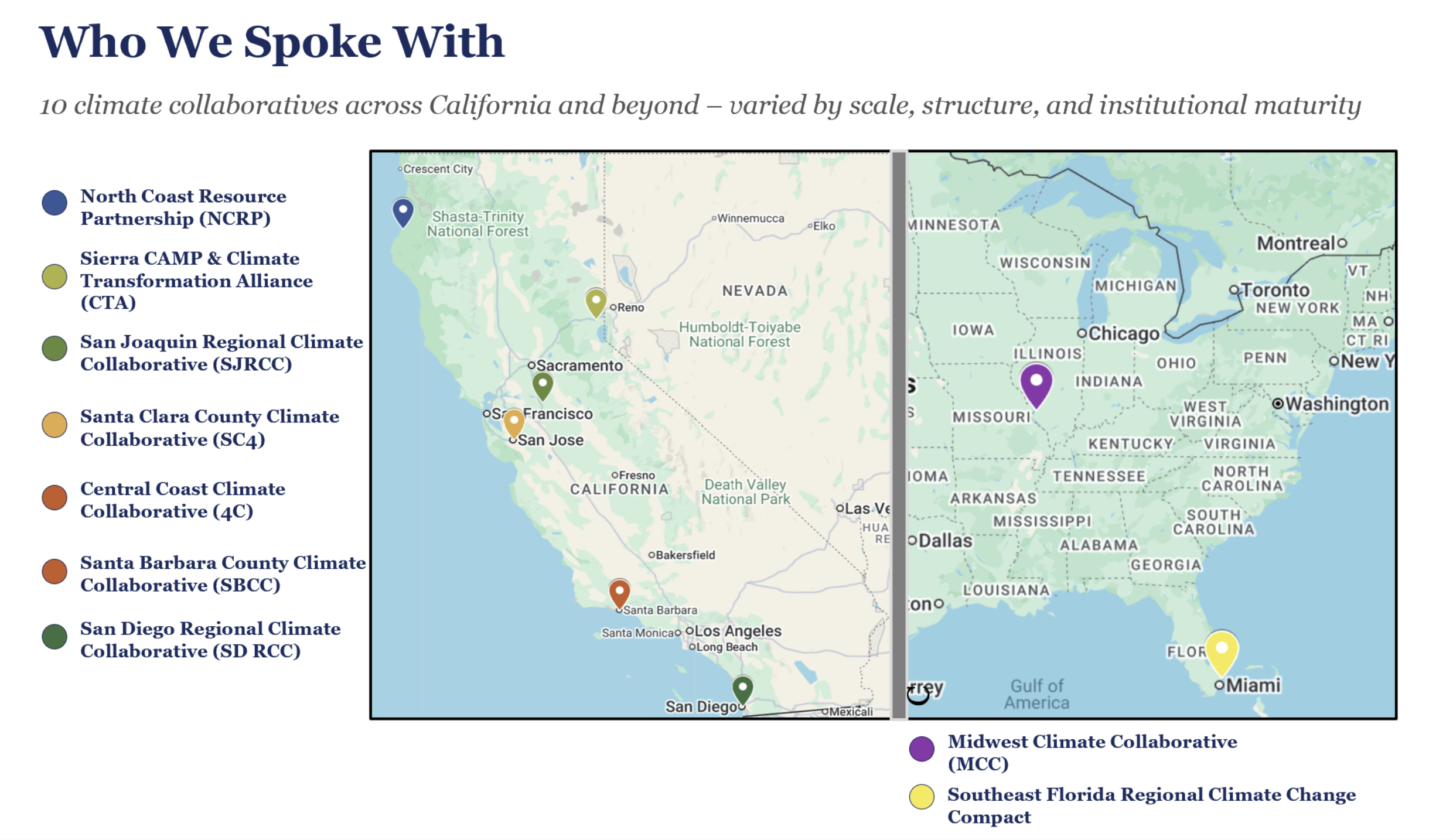
To capture a representative snapshot of the field, the Project Team conducted in-depth interviews with staff and leadership from ten collaboratives across the United States, varying in scale, structure, and institutional maturity. The Project Team synthesized the data through thematic and comparative analysis, identifying recurring patterns across cases that no single interview could reveal on its own.
What stood out most to me was how climate collaboratives emerged out of necessity, as local governments and regional actors realized that climate impacts could not be solved within isolated jurisdictional boundaries. It was interesting to understand the integral role they play in climate action as alternative governance structures despite unstable funding and shifting political landscapes."
—Judith Nasambu Wanjallah, UC Davis EPM Policy Clinic
Key Findings
Across ten collaboratives, three consistent findings emerged on what it takes to sustain regional climate collaboratives.
1. The funding problem is structural, not just financial. The majority of state and federal grants fund project deliverables, such as plans, studies, or project design, but rarely fund the coordination and infrastructure needed to produce them - the standing meetings, relationship building activities, and the administrative backbone that holds a network together between grant cycles. Darbi Berry, Executive Director of the San Diego Regional Climate Collaborative, described the challenge as one of the hardest her organization faces: securing funding not for a specific project or deliverable, but simply for the core work that makes everything else possible. The collaboratives that demonstrated the greatest resilience were not those that received the largest amount of funding, but rather those with the most stable funding . The North Coast Resource Partnership, which has managed approximately $150 million in grants over two decades, described its base funding from Sonoma County Water Agency as absolutely critical - present since day one, not tied to any deliverable, and the foundation on which everything else is built.
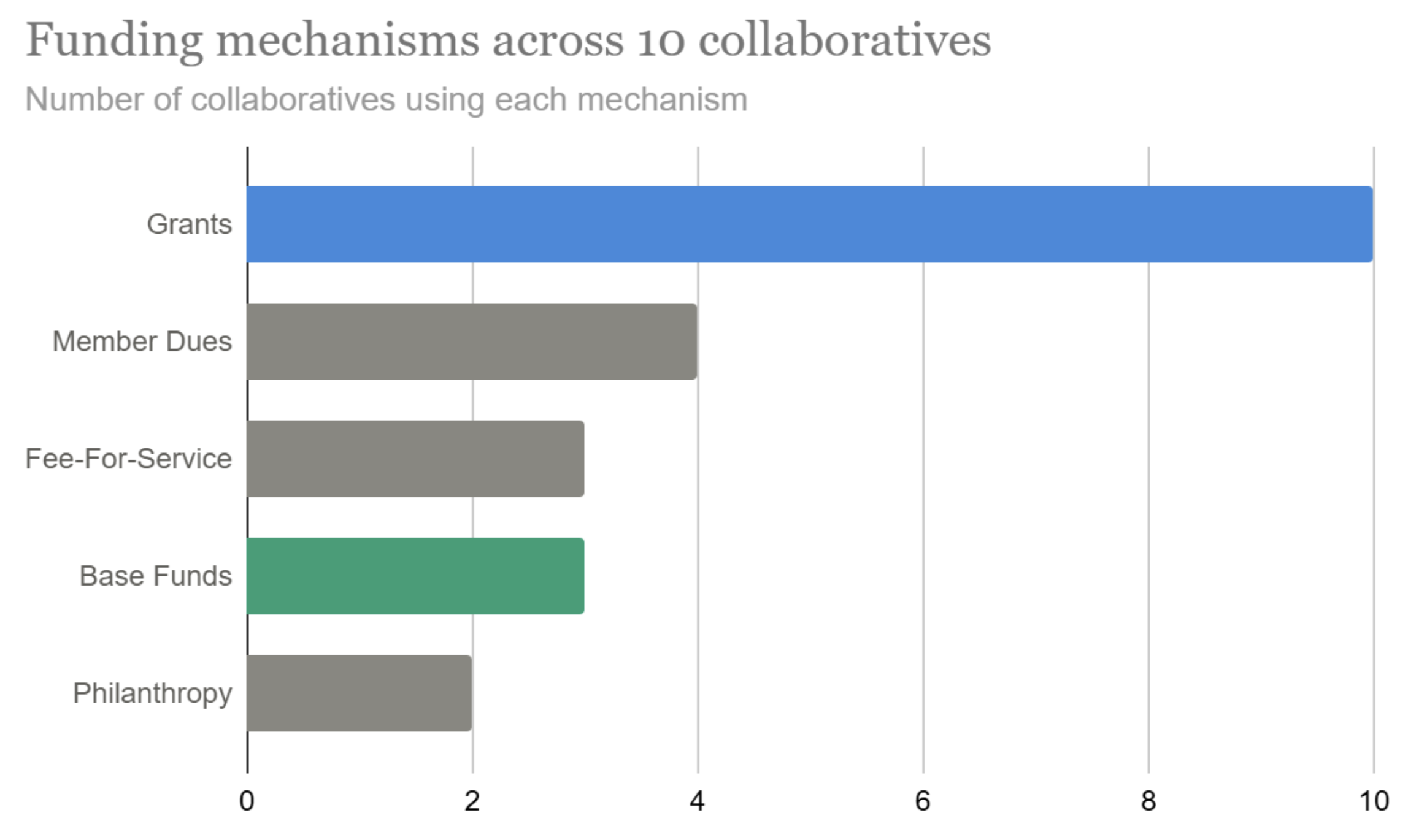
Every collaborative interviewed relies on grants. Stable base funding reaches only three.
I found the relationships between institutional backbone and what resources might be available to a climate collaborative fascinating. The opportunities available to some collaboratives and the restrictions others might face from this decision were eye-opening."
—Shivam Gandhi, UC Davis EPM Policy Clinic
2. Governance structure determines the trajectory of collaboratives. The choice of institutional anchor - often a county government, a university, or an independent fiscal sponsor - shapes not only how decisions are made but which funding opportunities exist. No single model proved more effective than another. What mattered was whether the collaborative understood the constraints its structure imposed and how to work within them.
3. Resilience is relational before it is structural. The collaboratives that have been most resilient to the federal rollback of climate funding and prioritization did so because of the depth of their relationships, not the strength of their governance documents. Jennifer Jurado, Chief Resilience Officer at Broward County and part of the leadership at Southeast Florida Compact, described every public convening of the Compact as carrying the feeling of a reunion among people who share a deep sense of community, mutual support, and common purpose - a spirit that has held even as funding pressures have tested the collaborative. Leaders like Heather Navarro at the Midwest Climate Collaborative and Darbi Berry at the San Diego Regional Climate Collaborative spoke about their work - not despite the frustrations but through them, with a genuine sense of being part of something larger than any single organization or grant cycle.
I enjoyed learning about the innovative ways in which climate collaboratives have adapted to funding and institutional challenges over the years. I found the role of community networks in maintaining and strengthening collaboratives to be especially fascinating, as it exemplifies one of the strengths of this alternative governance model."
—Junna Faessel, UC Davis EPM Policy Clinic
What the Conversations Taught Us
What the research revealed underneath all three findings was a tension between sustainability and inclusivity that no collaborative has fully resolved. The collaboratives navigating this most thoughtfully have instead designed around this tension, formalizing enough to function without becoming exclusionary. That balance is an ongoing choice.
What fascinated me the most was unpacking the unique ecosystem of each of these collaboratives. It was illuminating to see how they actively design around constant funding and capacity constraints — proving that you don't need a massive budget to create a massive regional impact if your network architecture is built right."
—Amy Hoa Nguyen, UC Davis EPM Policy Clinic
Where We Go From Here
Climate collaboratives continue to provide incremental change for communities that lack critical resources and capacity a space and mechanism to align on regional priorities, particularly in politically fraught regions. And the people running them are not waiting for conditions to improve before doing the work.
This fall, the Resilient California Summit in Sacramento featured a climate collaborative-only convening space - a sign that the field is organizing, connecting, and continuing to grow even as the ground shifts beneath it.