


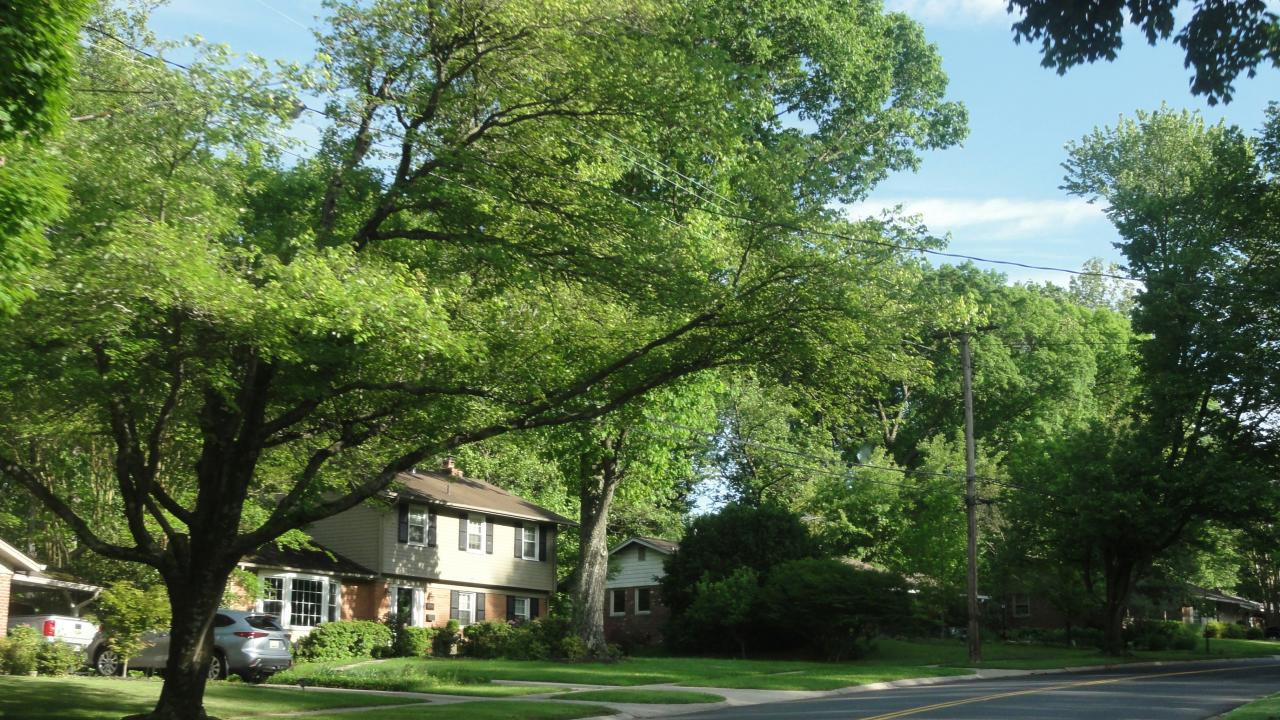
Tree Canopy in Neighborhood
Towards Urban Forest Equity: Evaluating Tree Canopy in Sacramento County’s EJ Communities
Junna Faessel is a 2nd year graduate student in the Environmental Policy and Management Program specializing in Conservation Management and Environmental Data Science. Her interest in public service work at the intersection of ecosystem conservation, public policy, and geospatial sciences led her to working with the Sacramento County Office of Planning and Environmental Review on the County’s Climate Action Plan, specifically the upcoming Urban Forest Management Plan (UFMP).
Urban forests are essential green infrastructure for sustainable and healthy communities, providing valuable ecosystem services with numerous ecological, cultural, and health benefits. However, these benefits are unequally distributed across urban landscapes, with lower-income neighborhoods and communities of color consistently having less tree cover and access to green spaces. UFMPs provide an opportunity to address these environmental injustices, but require accurate, detailed, and consistent data at multiple scales to capture complex socio-ecological trends and dynamics. While Sacramento County had target goals for its urban forest, it lacked the essential tree cover data across its jurisdiction to begin developing the UFMP.
For her Practicum, Junna addressed this critical data gap by: 1) leveraging high-resolution NAIP aerial imagery and advanced geospatial modeling techniques to determine the extent, distribution, and quality of urban tree cover in Sacramento County’s Environmental Justice (EJ) Communities; and 2) conducting a preliminary evaluation of existing ecological and socioeconomic conditions within each EJ Community to identify potential priority planting areas.
The first component of her Practicum involved an object-based image analysis classification to identify land cover classes and tree canopy cover in the study areas. The extracted tree canopy layer was then geographically and statistically analyzed at multiple scales, including land use, zoning, and census tract. The second component involved a range of research and analyses on relevant indicators such as urban heat island effect, proximity to green space, and cumulative environmental burden to develop a flexible needs analysis tool that identifies potential priority planting areas. Finally, she provided urban forestry and environmental justice recommendations for the UFMP based on assessment results and findings from the literature.
Junna’s work establishes an essential baseline for monitoring tree canopy cover throughout the EJ Communities and provides a foundation for developing informed community goals and actionable policies in the upcoming Urban Forest Management Plan. The Practicum further impressed upon her the importance of robust data analyses and interdisciplinary approaches to effective natural resource management in the face of a changing climate.